
Dr. Peggy Whitson
Record-Breaking Astronaut
About
Precious few human beings are able to say they’ve been lucky enough to travel to space. Peggy Whitson, however, is in a league of her own. Whitson has an incredible list of record-breaking accomplishments to her name. She was the first woman to command the International Space Station twice (2008 & 2013), she became the first non-military Chief Astronaut, completed ten spacewalks—the most by any woman—and spent a record 695 cumulative days in space, more than any American astronaut. Her dedication and commitment to space exploration and research earned her an induction into the U.S. Astronaut Hall of Fame in 2025 and the recipient of the National Space Trophy in 2026.
Unsurprisingly, behind all of these tremendous accomplishments lies one of the most passionate, knowledgeable, and courageous scientists in the world today. While she was breaking records, Dr. Whitson was also conducting groundbreaking research on a wide breadth of subjects with enormous implications for the future of humanity—robotics and artificial intelligence, medicine, agriculture, logistics, engineering, marine life, and beyond.
Dr. Whitson’s remarkable life story is a thrilling example for others to follow, from humble beginnings on a farm to her daring tales of spaceflight and crash landings in the steppes of Kazakhstan, leaving audiences on the edge of their seats. She was named as one of TIME’s Magazine's Most Influential People (2018), was on the cover of National Geographic Magazine, and was one of eight astronauts featured in Darren Aronofsky’s National Geographic series One Strange Rock.
Dr. Peggy Whitson is a former NASA astronaut and biochemist who began her career at NASA/Johnson Space Center as a Research Biochemist in the Biomedical Operations and Research Branch. During her time at NASA, she developed negotiation and leadership skills as a member of the U.S.-USSR Joint Working Group in Space Medicine and Biology. She continued developing these skills when she was named the Project Scientist of the Shuttle-Mir Program and served in this capacity until the conclusion of the Phase 1A Program in 1995. Dr. Whitson held the additional responsibilities of the Deputy Division Chief of the Medical Sciences Division at Johnson Space Center from 1995 to 1996 and served as Co-Chair of the U.S.-Russian Mission Science Working Group.
Selected from thousands of applicants, Dr. Whitson began her Astronaut training in 1996. Upon completing two years of training and evaluation, she was assigned technical duties in the Astronaut Operations Planning Branch and served as the lead for the Crew Test Support Team in Russia from 1998 to 1999. Soon after, Whitson was then selected to fly her first space mission to the International Space Station (ISS) Jun-Dec 2002, launching and landing on a Space Shuttle. During this 6-month mission, she became the first Science Officer of the ISS and conducted one spacewalk in the Russian Orlan spacesuit.
From November 2003 to March 2005, she served as Deputy Chief of the Astronaut Office. Also in 2003, she served as commander of the fifth NASA Extreme Environment Mission Operations (NEEMO) mission in the underwater habitat, Aquarius. In 2005, Whitson began training for the 16th Expedition to the ISS. She launched in Nov 2007 on her second 6-month mission, and served as the first female Commander of the ISS, conducting 5 spacewalks as a part of the ISS assembly.
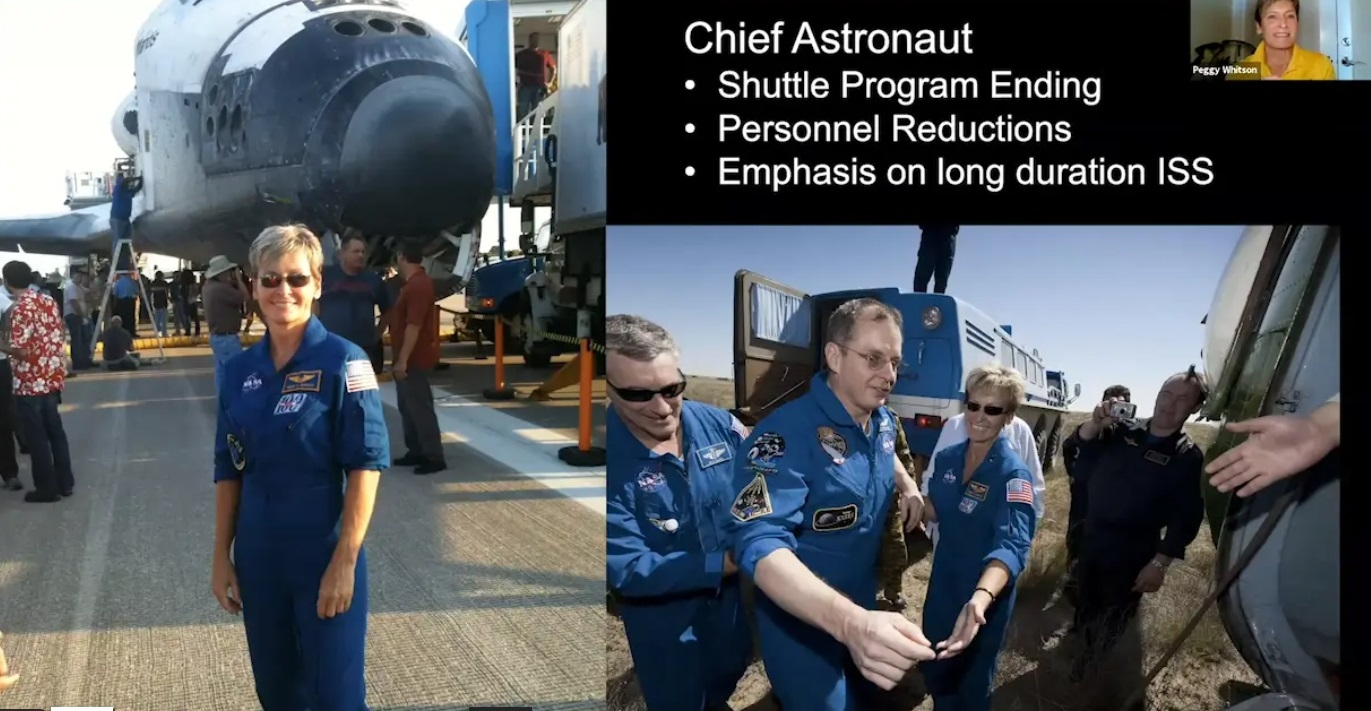
After returning from her second long duration mission, Whitson continued serving in a number of leadership roles, culminating in the Chief of the Astronaut Corps between October 2009 to July 2012. She was responsible for the mission preparation activities and on-orbit support of all International Space Station crews and their support personnel. She was also responsible for organizing the crew interface support for future commercially-provided cargo and crew transport vehicles. Whitson was the first female nonmilitary Chief of the Astronaut Office.
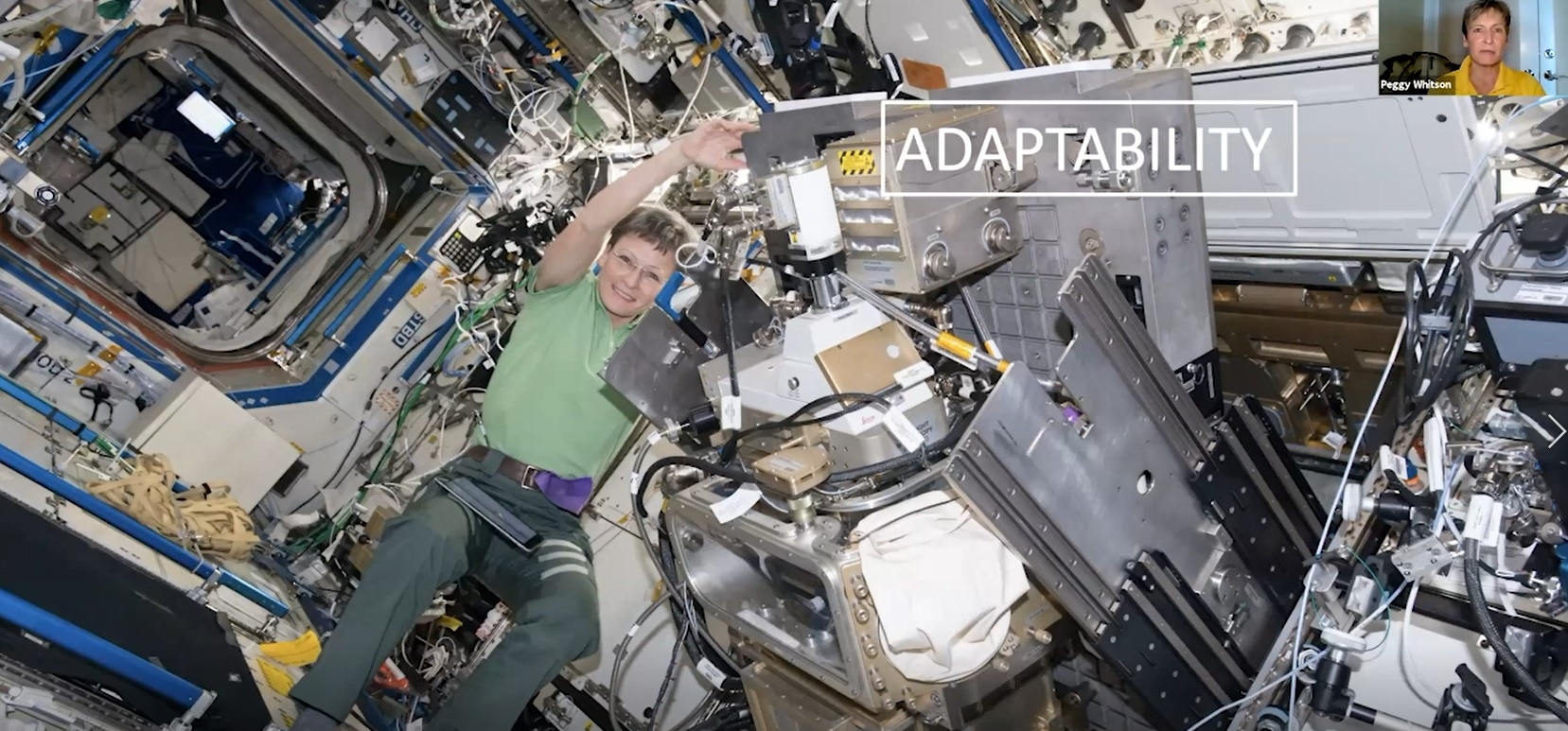
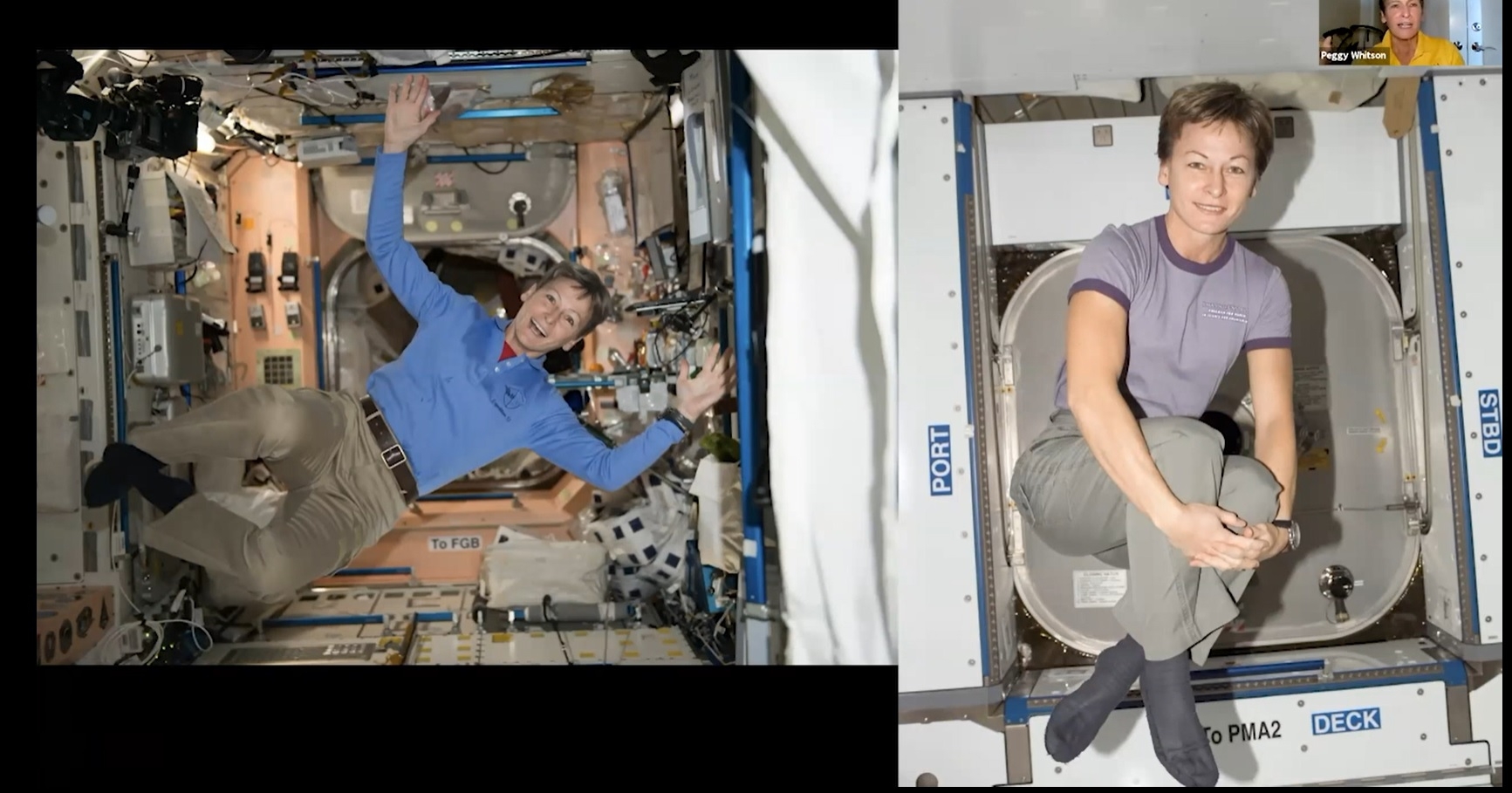
Whitson’s third mission launched in November 2016. Originally planned as a 6-month mission, she was extended to a nine-and-a-half-month mission, returning in September 2017, accumulating the records noted above while accomplishing an enormous wealth of scientific research and 4 additional space walks.
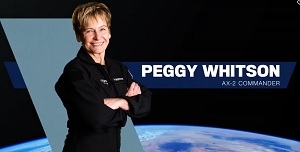
Following her retirement from NASA in 2018, Whitson joined Axiom Space and announced her return to space in 2021. After serving as backup commander for Axiom Mission 1 (Ax-1), she commanded Axiom Mission 2 (Ax-2) in 2023 and Axiom Mission 4 (Ax-4) in 2025. During Ax-4, she became the oldest woman to orbit Earth and extended her record to 695 cumulative days in space. She now serves as Vice President of Astronaut Operations at Axiom Space, helping lead the transition from government-led missions to the next generation of commercial space stations, as well as providing her insights into the development of the AxSuit that will be used on the lunar surface.
Whitson graduated from Mt. Ayr Community High School, Mt. Ayr, Iowa, in 1978; received a Bachelor of Science in Biology/Chemistry from Iowa Wesleyan College in 1981 and a Doctorate in Biochemistry from Rice University in 1985.

MEDIA



Related Speakers

© 2026 United Talent Rights Reserved.
VERSION NEXT-PUBLIC-VERSION-NUMBER